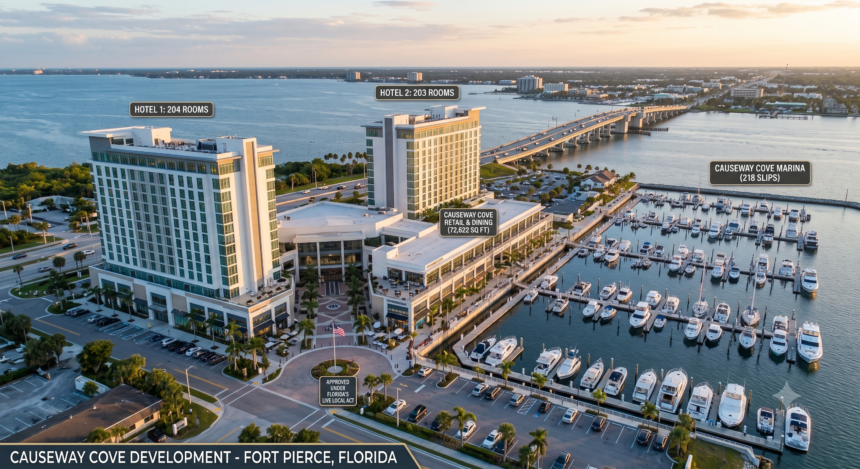
A real estate developer is leveraging Florida’s Live Local Act to build the largest project in Fort Pierce’s history, Causeway Cove, much to the dismay of local residents.
Construction on the city’s largest project ever is set to begin later this year, with the city having little say in the matter.

Causeway Cove, a massive five-building complex planning to use Florida’s Live Local Act to bypass local zoning controls, is scheduled to begin construction later this year, provided it meets the city’s approval conditions, according to the project timeline.
The proposed 930-unit development at 601 Seaway Drive moved forward during Monday’s Planning Board meeting, where members and a packed room learned the city has no authority to hold a public hearing or put the project to a vote. The application was filed under Florida’s Live Local Act (Statute 166.04151), which mandates administrative approval and prohibits public hearings.
What does the Causeway Cove project include?
The development spans approximately 43 acres south of Seaway Drive. The project scope includes:
- 930 units in total, including 366 residential housing units.
- Two hotels (one with 204 rooms and another with 203).
- Just over 72,000 square feet of commercial space.
- A marina with 218 slips.
- Five buildings with heights ranging from 11 to 17 stories.
- 1.3 million square feet of total built area.
The project’s density equals 22 units per acre. Under the Live Local Act, a developer can claim the highest density allowed anywhere in the city (up to 30 units per acre) and the maximum building height permitted within a one-mile radius, which in this case reaches 200 feet.

The city staff attached 31 conditions to the development order, which cannot be modified by the board or the city commission.
Traffic, evacuation, and the south bridge
The traffic study projects an average net increase of approximately 6,700 vehicle trips per day, while the county’s study shows an average increase of over 50 percent, and this is outside of peak season.
The most recent census tract, which runs from the cove to Heron Boulevard, shows a permanent population of about 3,426 residents. The project would add an average population of around 2,657 people, representing a 77 percent increase, not counting labor staff, marina users, restaurant traffic, and shoppers.

Seaway Drive is a state road under the jurisdiction of the Florida Department of Transportation (FDOT). The FDOT has required an overlap phase for right turns westbound at U.S. 1 and Seaway Drive and will separately decide whether to allow a traffic light at the site’s entrance. The FDOT retains control over the connection permit and can approve or deny it.
30-year affordability requirement
The Live Local Act requires that at least 40 percent of the units be set aside at state-defined affordable rates for a minimum of 30 years.
Since the statute does not provide cities with a methodology to oversee compliance, the city drafted its own condition requiring the developer to maintain records on a compliance platform and submit an annual report by January 31 each year.
Residents speak during general comments
Residents were not allowed to address the Causeway Cove topic directly during the presentation. They were only permitted to speak during the general comments period at the end of the meeting.
Edey Harrison, a Harbour Isle resident, questioned the density calculations. She noted that of the 43 acres, 25.5 are submerged lands where the city’s own ordinances prohibit construction. She argued that the actual buildable area is reduced when excluding these lands, while the density calculation still uses the full parcel. She also raised concerns about soil contamination—pointing out the site transitioned from a mobile home park to an active shipyard adjacent to a water treatment plant—and questioned the impacts of dredging on the anchored bridge next to the property.
Kevin Keane, a Palmetto Avenue resident, focused his remarks on the public beach across from Seaway Drive, maintained under a 1937 lease by the Fort Pierce Port Authority. He raised questions about the beach’s capacity, whether more parking, restrooms, and public safety services will be needed, and who will bear those costs.
How is the application moving forward?
There will be no city vote or city commission hearing. The application is proceeding administratively.
The developer still needs FDOT access approvals, construction permits, and sign-offs from the South Florida Water Management District (SFWMD), the Department of Environmental Protection (DEP), the fire district, and potentially the Army Corps of Engineers. None of these checkpoints belong to the City of Fort Pierce.
There is a separate application already under review for Seaway Drive that includes a conference center, condominiums, a parking lot, and commercial spaces for restaurants. That project was not filed under the Live Local Act, meaning the Planning Board will have the opportunity to comment on it and put it to a vote.
The full meeting video is available through the City of Fort Pierce.
Frequently Asked Questions about Causeway Cove in Fort Pierce
How many units are planned for the Causeway Cove development? The project includes a total of 930 units, of which 366 are residential housing units. The rest includes two hotels with 204 and 203 rooms, respectively.
Why can’t the Fort Pierce Planning Board vote on this project? The application was filed under Florida’s Live Local Act, Statute 166.04151, which requires administrative approval and prohibits public hearings.
What affordability requirements apply to the Seaway Drive development? The Live Local Act requires that at least 40 percent of the units be reserved at state-defined affordable prices for a minimum of 30 years.
How many daily vehicle trips does the traffic study project? The traffic study projects an average net increase of approximately 6,700 trips per day, while the county’s study shows an average increase of over 50 percent outside of peak season.
Which agencies still need to approve the project? The applicant still needs FDOT access approvals, construction permits, and authorization from the South Florida Water Management District, the Department of Environmental Protection, the fire district, and possibly the Army Corps of Engineers.