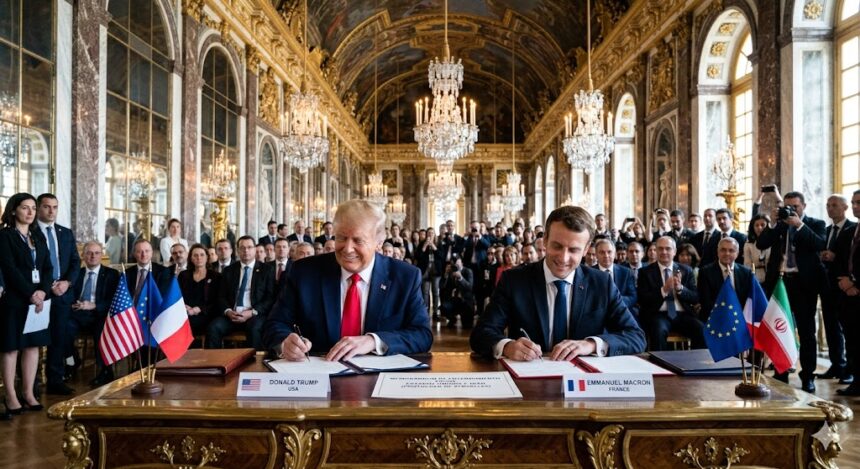
Indeed, this historic event has just taken place at the Palace of Versailles, marking a crucial turning point after more than three months of hostilities and a severe global energy crisis.
The 14-point provisional agreement establishes a “step-by-step peace” framework that has immediately begun reshaping the global geopolitical and economic landscape.

The announcement was made by Trump himself after a gala dinner during the G7 summit, hosted by French President Emmanuel Macron. With this signing, a strict 60-day deadline (extendable by mutual agreement) is activated for technical teams to negotiate a definitive peace treaty addressing Tehran’s nuclear program and regional security.
The 5 Key Points of the Versailles Memorandum
- Immediate cessation of hostilities: A permanent end to military operations on all fronts is decreed, explicitly including the de-escalation of conflict in Lebanon.
- Reopening of the Strait of Hormuz: After months of blockade that triggered a global energy crisis, the maritime route reopens immediately. Iran commits to guaranteeing safe and free passage (without tolls) for commercial vessels during the 60-day truce.
- Economic relief and oil exemptions: While official sanctions remain in place until the final agreement, Washington will immediately issue exemptions (waivers) so Iran can freely export oil and derivatives and conduct banking and transportation transactions.
- Oversight of enriched uranium: Iran reaffirms its commitment not to develop nuclear weapons and agrees to allow the International Atomic Energy Agency (IAEA) to oversee on-site the dilution and reduction (down-blending) of its highly enriched uranium stockpiles.
- Reconstruction fund: An international fund of up to $300 billion is projected for economic development and infrastructure in Iran, financed by regional partners, once the definitive agreement is reached.
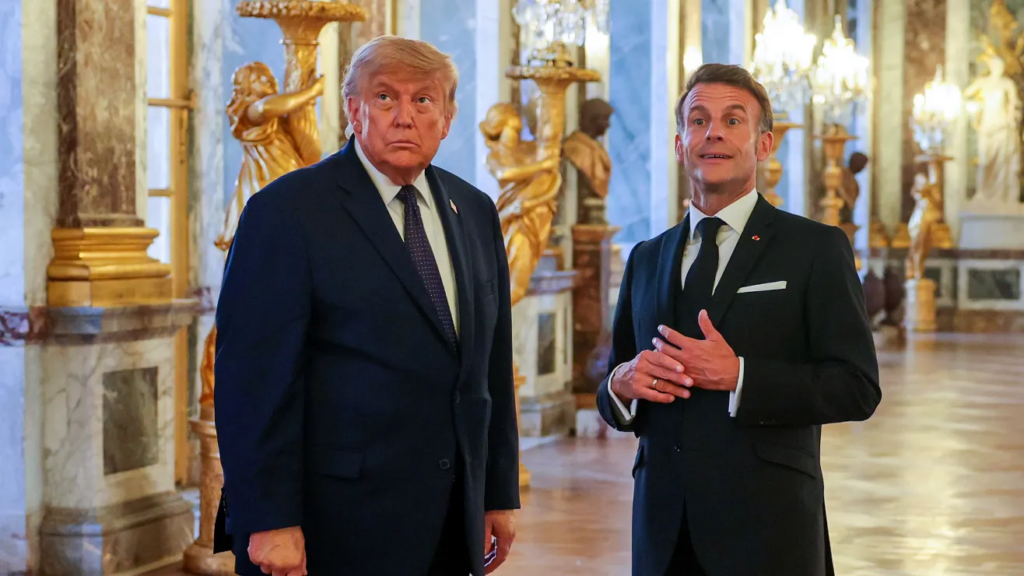
“If I Don’t Like It, We’ll Start Bombing Them Again”
True to his negotiation style, Trump described the pact as “very strong” and necessary to stabilize global financial markets, but made clear that the military option remains on the table if Tehran fails to meet expectations in technical negotiations:
“It’s a memorandum of understanding. If I don’t like it, we’ll start shooting and bombing them again. (…) As long as they behave, I don’t really care [about the deadline]; we have cameras watching every inch of their enriched material.”
Immediate Criticism on the Domestic Front
Despite the White House’s optimism, the agreement is already facing strong resistance in the U.S. Congress, even within Trump’s own Republican Party. Hardline senators have called the memorandum “the worst foreign policy mistake in decades,” arguing that it grants Iran immediate and massive economic relief without definitively dismantling its nuclear infrastructure or regional influence.
Image: ElHispanoParaTodos/PRESS