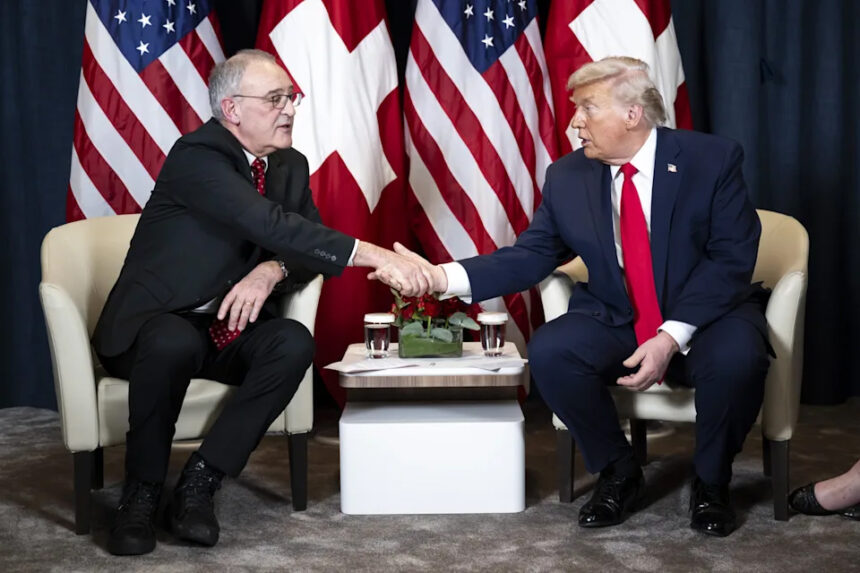
It’s no longer a rumor. Trump and Mark Rutte confirm a framework agreement to define the strategic control of Greenland. Purchase, lease, or protectorate? We analyze the masterstroke for the Arctic.
By: El Hispano Para Todos Editorial Team | Reading time: 11 min

What began in 2019 as a headline many took as a joke has today, Wednesday, January 21, 2026, become a geopolitical reality shaking the foundations of the transatlantic alliance.
Forget the memes of golden towers in the ice. This is serious.
President Donald Trump, true to his “Art of the Deal” style, has achieved the unthinkable: sitting down with NATO Secretary General Mark Rutte and leaving the room with a signed document. It’s not a bill of sale (yet). It’s something more complex and strategic: a “Framework for Cooperation and Shared Sovereignty in the Arctic.”
Why now? And what does it really mean for the United States to “negotiate the future” of the world’s largest island?

The short answer is: China and Russia. The long answer is explained below, because this will change the map as we know it.
The Announcement: “A Security Shield for the Hemisphere”
In a joint press conference that broke all usual Brussels protocols, Trump went straight to the point.
“We have agreed with my friend Mark [Rutte] that Greenland cannot remain a blind spot. It is vital to the security of the United States and all of NATO. We will negotiate its future, its development, and its protection. Denmark has been a great partner, but the game has changed.” — Donald Trump.
The framework agreement establishes three fundamental pillars that will begin to be discussed immediately:

- Massive Military Expansion: Thule Air Base (now Pituffik) will cease to be an outpost and become the Arctic’s neural command center.
- Exploitation of Critical Resources: The United States seeks preferential access to Greenland’s rare earth minerals, breaking China’s monopoly.
- Direct Economic Injection: A financial stimulus package that would go directly to Nuuk (Greenland’s capital), largely bypassing Copenhagen.
Why Greenland? (It’s Not About the Ice)
To understand the Trump administration’s obsession with this territory, you have to look at the map from above, from the North Pole.
If you control Greenland, you control the entry and exit of the North Atlantic. It’s the bottle’s cork.
1. The Rare Earths War
Here’s where the real money is. Greenland holds some of the world’s largest deposits of neodymium, praseodymium, and uranium. These minerals are essential for everything: from your iPhone’s batteries to hypersonic missile guidance systems.
Currently, China controls the market. Trump wants Greenland to be the West’s “security mine.” If the U.S. secures these exploitation rights under NATO’s umbrella, it’s a direct blow to Beijing’s strategic economy.
2. The New Polar Silk Road
Climate change is melting the ice, and while that’s an ecological tragedy, it’s a brutal commercial opportunity. The new shipping routes opening in the north cut travel time between Asia and Europe by weeks. Whoever controls Greenland’s territorial waters will collect the toll on future global trade.
NATO’s Position: Rutte on the Tightrope
Mark Rutte, known for his pragmatism, finds himself in a delicate position. As NATO’s chief, his job is to keep the alliance united.
On one hand, he knows Europe cannot defend the Arctic alone against Russian aggression. It needs American military muscle. On the other hand, he has Denmark (a founding NATO member) shouting “sovereignty.”
Rutte’s body language during the announcement was revealing: cautious, serious, but nodding. The subtext is clear: NATO prefers Greenland under stronger American influence than risking it falling under Chinese economic sway.
Denmark and the Greenlanders: What Do They Say?
This is where things get tense. In 2019, the Danish Prime Minister called the idea “absurd.” Today, the tone is one of “constructive concern.”
But the real player here isn’t Denmark; it’s Greenland’s local population (about 57,000 inhabitants). The independence movement on the island is strong.
Trump’s strategy seems to be seducing the Greenlanders directly. “Let’s be honest: Denmark gives you an annual subsidy. We can triple that and turn your airports into international hubs,” appears to be the unwritten offer. It’s a classic real estate move: if the owner won’t sell, talk to the tenant.
Comparison: Current Status vs. Trump’s 2026 Proposal
| Aspect | Current Situation (Kingdom of Denmark) | Trump/NATO Vision (Framework Agreement) |
| Defense | Danish responsibility (limited) | “Arctic Fortress” (US Space Force + Navy) |
| Economy | Danish subsidy ($600M/year) | Direct investment in infrastructure and mining |
| Resources | Restrictive local legislation | Accelerated exploitation “Fast-Track” |
| Sovereignty | Danish autonomous territory | Possible status as “Freely Associated State” or Protectorate |
Analysis: Can a Country Really Be “Bought” in 2026?
Not with a check at a window. But in practice, yes.
What we’re seeing isn’t a 19th-century real estate transaction (like the purchase of Alaska or Louisiana). It’s a hybrid geopolitical acquisition.
Most likely, the final outcome won’t be Greenland becoming the 51st state overnight. The most feasible model is similar to that of the Marshall Islands or Palau: independent nations but with their defense and foreign policy entirely delegated to the United States in exchange for massive funding.
Mark Rutte knows it. Trump knows it. And while teeth may grind in Copenhagen, the reality is that when a superpower decides a territory is “existential” for its security, the rules of the game change.
Conclusion: The Ice Heats Up
This framework agreement is just the starting whistle. Fierce negotiations lie ahead. We’ll see American diplomats traveling to Nuuk, protests in Copenhagen, and surely Russian submarines getting too close to test the alliance’s nerves.
Trump has planted a flag in the ice. Now we’ll see if he can keep it there.
Image Yahoo.com