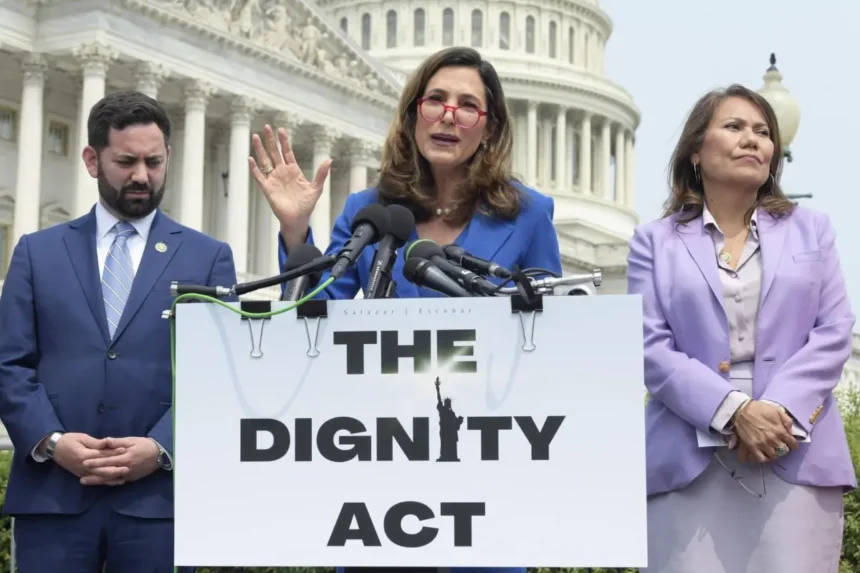
Another Bipartisan Immigration Reform Proposal Advances, Offering Legal Status to Certain Undocumented Immigrants, Though No Definitive Solutions Are in Sight
In a frequently divided Congress, a bipartisan immigration bill known as the Dignity Act represents one of the most significant attempts in recent years to reform the U.S. immigration system.
Led by Representatives María Elvira Salazar (Republican from Florida) and Veronica Escobar (Democrat from Texas), the proposal seeks a two-pronged solution: strengthening border security while simultaneously creating a pathway to legal status for millions of undocumented immigrants already residing in the country.

“For 40 years, every president and Congress has looked the other way while millions have lived here illegally, many working in key industries that keep our economy running. It’s the Achilles’ heel that no one wants to fix,” Salazar said in a statement. “The Dignity Act offers a commonsense solution: certain undocumented immigrants can obtain legal status—not citizenship—by working, paying taxes, and contributing to our country. No handouts. No shortcuts. Just responsibility and a path toward stability for our economy and our future.”
The legislation, which was reintroduced in an updated version in July 2025, builds on an original 2023 proposal (H.R. 3599) and is presented as a compromise to address one of the most contentious issues in U.S. politics.
Key Points of the Dignity Act Proposal
The bill is structured around two main programs that would operate consecutively, along with a robust border security component.
1. Strengthening Border Security: The proposal allocates billions of dollars to modernize border infrastructure. This includes the use of advanced technology such as drones and surveillance cameras, as well as hiring more Border Patrol agents. A central feature is the implementation of a mandatory nationwide E-Verify system for employers to verify the immigration status of their workers.
2. The Dignity Program (Step 1): This seven-year program would offer undocumented immigrants who have lived in the U.S. for more than five years the opportunity to obtain temporary legal status. To be eligible, applicants would need to:

- Pass a rigorous criminal background check.
- Pay back taxes.
- Contribute to a restitution fund with a total payment of $5,000 over the duration of the program.
Under the “Dignity” status, participants could work legally, travel outside the country, and be protected from deportation.
3. The Redemption Program (Step 2): Upon completing the Dignity Program, immigrants would have the option to enter the Redemption Program. This second five-year program would offer a pathway to permanent residency (green card). To qualify, participants would need to:
- Pay an additional contribution to a fund for training U.S. workers.
- Meet requirements for English language proficiency and U.S. civics education.
Once permanent residency is obtained, the possibility of applying for U.S. citizenship through existing channels would open.

A Different Path for ‘Dreamers’
The Dignity Act also includes an accelerated pathway to permanent residency and citizenship for undocumented youth who arrived in the U.S. as children, known as ‘Dreamers,’ as well as for beneficiaries of Temporary Protected Status (TPS).
Positions and Perspectives
In Favor: Supporters of the bill, including a coalition of business, agricultural, and religious groups, view it as a pragmatic and humane solution. They argue it would bring millions out of the shadows, allowing them to contribute openly to the economy through taxes and legal employment. They emphasize that the border security component is essential to gaining conservative support. Representative Salazar has stressed that this is not “amnesty,” but rather an “earned opportunity.”
Opposed: Despite its bipartisan nature, the bill faces criticism from both ends of the political spectrum. Some hardline Republicans oppose any form of legalization, viewing it as a reward for those who broke the law. Meanwhile, certain immigrant advocacy groups criticize the lengthy process (over a decade for the possibility of citizenship), the financial costs for applicants, and the strict border security measures accompanying it.
Current Status and Future of the Proposal
The reintroduction of the Dignity Act in July 2025 marks a new attempt to advance immigration reform. While its passage in a polarized Congress remains a considerable challenge, the bipartisan backing of its authors and support from various sectors of society keep the possibility of serious legislative debate alive. The success of the proposal will depend on its advocates’ ability to build a broader coalition and convince their colleagues that a compromise approach is the only way to fix a system both sides agree is broken.