

Florida Amendment 3: Property Tax Reduction Approved
Translated with AI from the original article in Spanish. Leer la noticia original en español
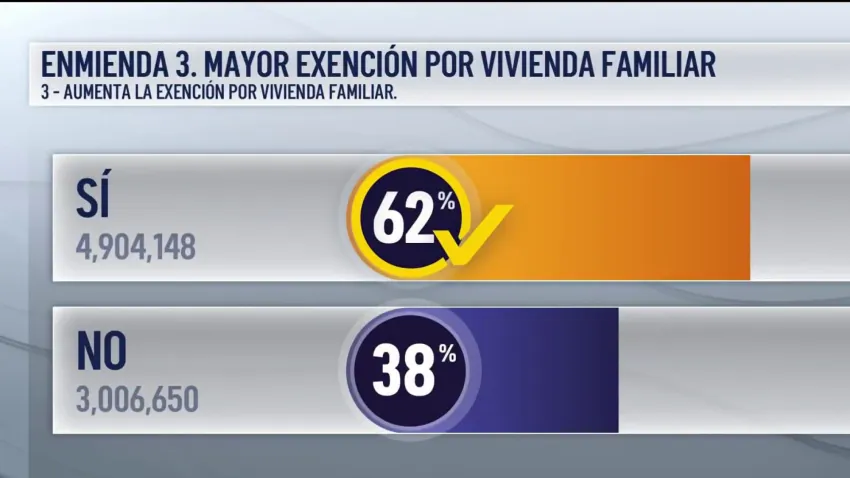
Voters in Florida have approved Amendment 3 in the November 2026 elections with 62% of the vote in favor, surpassing the required 60% constitutional threshold. The measure introduces a major tax reform that substantially reduces property taxes in the state while restricting revenue and spending margins for local governments.
Key changes for homeowners and properties
- Increase in Homestead Exemption: The exemption on the assessed value for non-school taxes will rise to $150,000 in 2027 and reach $250,000 in 2028, subsequently adjusting for inflation.
- Cap on commercial and rental properties: Starting in January 2027, the maximum annual increase cap on taxable value for non-residential or second homes (non-homestead) is cut in half, dropping from 10% to 5%.
- Requirement for new residents: Those moving to Florida starting next year must reside in the state for five years before they can qualify for the new expanded homestead exemption.
Impact on local budgets and other amendments
- Municipal revenue cuts and spending restrictions: Legislative economic analyses estimate that counties and municipalities will lose approximately $4.6 billion in the 2027-2028 fiscal year and $8.4 billion in 2028-2029. Additionally, the measure mandates that revenue be used exclusively for public safety, education, infrastructure, flood control, and essential operations.
- Rejection of Amendments 1 and 2: On the same election day, voters rejected Amendment 1 (aimed at expanding the state budget stabilization fund) and Amendment 2 (which proposed tax exemptions for agricultural machinery and equipment).
A practical example of how property tax savings are calculated in Florida with Amendment 3 in 2027 and 2028.
Savings under Amendment 3 apply exclusively to the portion of taxes that does not fund school districts (county, municipal, and special district taxes). Taxes designated for public schools maintain their fixed $25,000 exemption unchanged.
To see the real impact on a homeowner's pocket, let's take as a reference a primary residence (homestead) with a constant assessed value and average state millage rates.
Practical example parameters
- Assessed Value of the home: $350,000 (assuming the owner already meets the 5-year Florida residency requirement).
- School tax rate: 6 mills ($6 for every $1,000 of taxable value).
- Non-school tax rate (county and city): 12 mills ($12 for every $1,000 of taxable value).
| Concept | Base System (2026) | Year 1 Reform (2027) | Year 2 Reform (2028) |
| School exemption | $25,000 | $25,000 | $25,000 |
| School tax (6 mills) | $1,950 | $1,950 | $1,950 |
| Non-school exemption | $50,000 | $150,000 | $250,000 |
| Non-school taxable base | $300,000 | $200,000 | $100,000 |
| Non-school tax (12 mills) | $3,600 | $2,400 | $1,200 |
| Total annual bill | $5,550 | $4,350 | $3,150 |
| Annual savings vs. 2026 | — | $1,200 | $2,400 |
Step-by-step calculation breakdown
- School taxes (no change): Over the three years, the $25,000 school exemption is subtracted from the $350,000 assessed value, leaving a taxable base of $325,000. Applying the 6-mill rate ($325,000 ÷ 1,000 x 6), the annual payment to schools remains fixed at $1,950.
- 2026 Scenario (Before reform): With the standard exemption of about $50,000 for municipal and county taxes, the owner was taxed on $300,000 ($350,000 - $50,000). At a rate of 12 mills, they paid $3,600 in non-school taxes, totaling a bill of $5,550.
- 2027 Scenario ($150,000 exemption): By raising the non-school exemption by an additional $100,000, the taxable base drops to $200,000 ($350,000 - $150,000). Multiplied by 12 mills, the local tax drops to $2,400, generating direct savings of $1,200 per year ($100 per month).
- 2028 Scenario ($250,000 exemption): The exemption reaches $250,000, so the owner only pays local taxes on the remaining $100,000 ($350,000 - $250,000). The non-school tax is reduced to $1,200, doubling the annual savings to $2,400 ($200 per month) compared to 2026.
Key factors that may vary your exact figure
- Homes assessed at $250,000 or less: In 2028, any primary residence with an assessed value equal to or less than $250,000 will be 100% exempt from county and city ad valorem taxes, paying only the school portion and fixed service fees (such as trash collection or non-ad valorem special fire districts).
- 3% annual cap (Save Our Homes): In practice, the assessed value of a primary residence usually rises each year by a maximum of 3% or the inflation index, which will slightly moderate net savings compared to the static calculation.