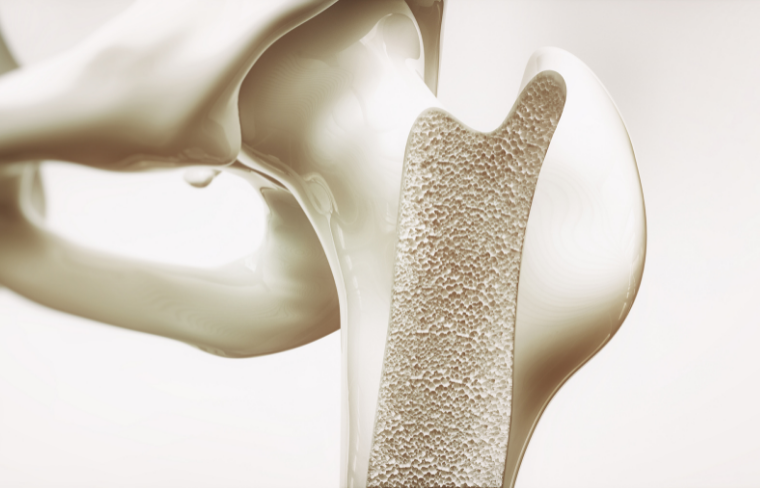
Recent scientific advances have opened new and exciting possibilities not just to halt the progression of osteoporosis but also to potentially reverse it by regenerating lost bone.
While a complete “cure” is still on the horizon, the latest research goes beyond traditional treatments and points to a future where bone reconstruction is a reality.

Below are the most promising discoveries in this field.
New Anabolic Drugs: Building New Bone
Unlike older medications that focus on slowing bone loss (antiresorptives), a newer class of drugs, known as anabolic agents, actively stimulates the body to form new bone tissue.
- Teriparatide (Forteo) and Abaloparatide (Tymlos): These medications are synthetic forms of a parathyroid-related hormone. They work by stimulating osteoblasts, the cells responsible for bone formation, leading to increased bone density and mass. Their use is typically limited to about two years.
- Romosozumab (Evenity): This is one of the most significant advances. It is a monoclonal antibody that works in a dual way: it blocks sclerostin (a protein that inhibits bone formation) and, in doing so, not only stimulates the growth of new bone but also reduces bone resorption. It is administered through monthly injections for one year and has proven highly effective in reducing fracture risk.
Emerging and Experimental Therapies: The Future of Bone Regeneration
Current research is exploring cutting-edge approaches that could revolutionize osteoporosis treatment.
1. Injectable Hydrogel to Strengthen Bones 🧪
A highly promising development comes from scientists in Switzerland. They have created an injectable hydrogel that, in preclinical studies with rats, has shown to increase bone density by 2 to 3 times in just a few weeks.

- How does it work? The gel is injected directly into the trabecular bone (the spongy internal structure of the bone). Once inside, it solidifies and acts as a scaffold that stimulates the adhesion of bone-forming cells. Over time, the body reabsorbs the hydrogel and replaces it with new, healthy bone.
- Advantages: Its main advantage is the speed at which it strengthens bones, offering much more immediate protection against fractures compared to current treatments, which can take months or even a year to show significant effects. Human clinical trials are the next crucial step.
2. Stem Cell and Secretome Therapy 🧬
Regenerative medicine is placing a major focus on the use of mesenchymal stem cells (MSCs).
- MSC Secretome: Spanish researchers have discovered that the molecules secreted by these stem cells (the “secretome”) could be key. They have designed a therapy based on this secretome that, in study models, demonstrated a dual mechanism: it protected bone from degradation while simultaneously stimulating its regeneration. This positions the secretome as one of the most promising strategies for future regenerative therapies.
3. Gene Therapy (CRISPR)
Although still in a highly experimental phase, the use of gene-editing tools like CRISPR is being explored to correct genetic defects that predispose individuals to bone loss. The long-term goal would be a one-time therapy that could address the underlying cause of osteoporosis in some patients.
What Does This Mean for Patients?
These discoveries are a source of great hope. While anabolic treatments like Romosozumab are already available and make a significant difference, hydrogel and stem cell therapies could offer faster and more effective solutions in the future for regenerating lost bone, bringing us closer to the possibility of significantly reversing osteoporosis.

It is essential for osteoporosis patients to discuss the newest and most suitable treatment options with their doctors, including the possibility of participating in clinical trials if appropriate.