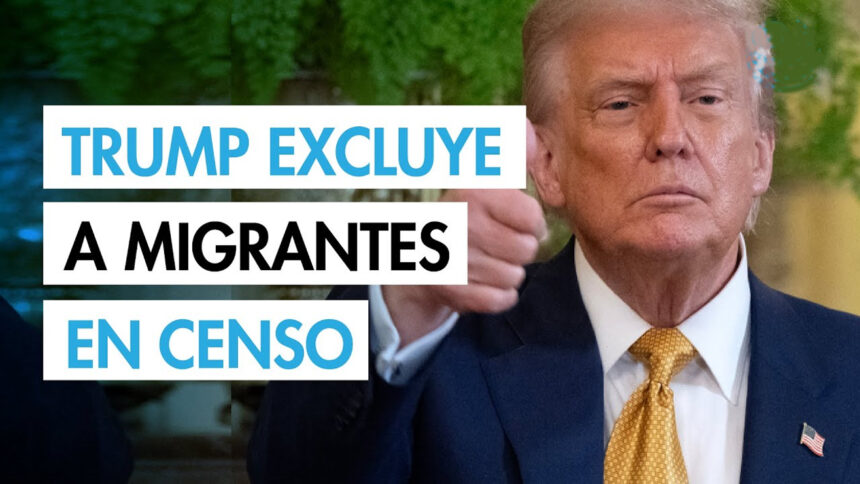
Since its independence, the United States has conducted a population census every ten years, coinciding with the turn of the decade. This tradition, enshrined in the Constitution, includes all residents of the country regardless of their immigration status. However, President Donald Trump has expressed his intention to break with this historic norm.
The 14th Amendment requires the census to count all people living in the U.S. and critics accuse Trump of attempting to use this measure as a way to hold onto power.

Trump’s new plan represents another front in his political battle. During the 2020 Census, his first administration (2017-2021) unsuccessfully tried to exclude undocumented immigrants from the official count and ultimately undercounted the Latino community.
Now, his proposal, once again labeled “unconstitutional,” appears to be part of a broader strategy to manipulate the redistricting of electoral districts.

Trump Excluded Over Three Million Latinos in 2020
During Trump’s first term, the Census Bureau omitted more than three million Latinos from the 2020 Census, while overcounting the non-Hispanic white population.
The net undercount rate for Latinos was 4.99%, a statistically significant figure that far exceeded the 1.54% recorded in 2010. The official count estimated a Hispanic population of 62.1 million, but that percentage equates to the omission of over three million people.

This undercount even surpassed that of the African American population, whose omission rate was 3.3%, a figure not significantly different from the 2.06% of the previous decade.
In contrast, the non-Hispanic white population was overcounted by 1.64%, also a statistically significant figure compared to the 0.83% recorded in the previous census.
Latino organizations and leaders directly blamed the Trump administration, denouncing deliberate political interference in the process.

At the same time, the president attempted to order the exclusion of undocumented immigrants from the census, but courts rejected the plan, reminding that only Congress has the authority to determine who should be counted.
No Authority to Alter the 2030 Census
Trump’s proposal exceeds the constitutional limits of the presidency. The authority to order additional censuses or modify the criteria for the count rests exclusively with Congress, which could do so through ordinary legislation.
However, these intermediate censuses are merely statistical, and their results are not used to redefine electoral districts.
Since 1790, the decennial census has been a constant even in times of crisis. Not even the COVID-19 pandemic in 2020 prevented its completion.
The Constitution establishes the frequency and methods of the count, which traditionally is conducted through door-to-door visits, mail, or phone. In 2020, for the first time, it was also possible to complete it online.
A Key Tool for Resources and Political Power
The census not only guides the distribution of federal resources for communities and public programs but also defines electoral districts and the number of representatives in Congress.
Therefore, any deviation in the count can alter the political balance and have direct consequences in local, state, or federal elections.
According to the latest official data, nearly 11 million undocumented immigrants lived in the U.S. in 2022.
Their exclusion from the 2030 Census could change the configuration of several districts and benefit the Republican Party in the 2026 legislative elections and the 2028 presidential election.
The Battle Over Electoral Districts
Trump’s announcement comes at a time of high political tension in Texas, where Democratic lawmakers are trying to block a redistricting plan pushed by the state’s Republican government.
The plan, backed by Trump, has been accused of favoring conservatives through gerrymandering, a political manipulation of electoral maps to consolidate majorities.
Image: DiarioNY