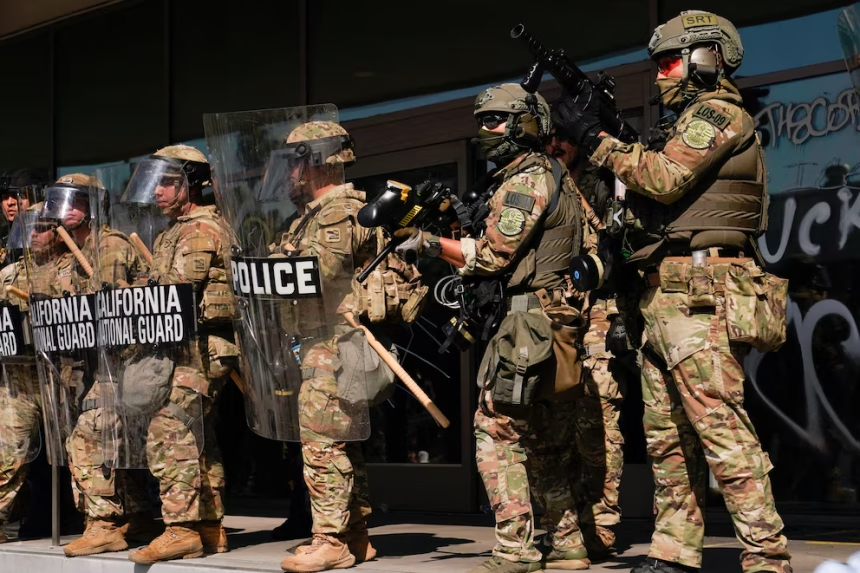
The deployment of the National Guard in Los Angeles, ordered by President Donald Trump, represents an exceptional action in recent U.S. history. The measure was adopted without the approval of California Governor Gavin Newsom or Los Angeles Mayor Karen Bass, in the context of protests stemming from immigration raids. Below are the key points explaining the scope of this decision:
- What happened and why was the National Guard deployed?
- What laws did Trump use to justify the measure?
- Why is this measure unusual?
- What are the precedents for similar deployments?
- What actions has California taken in response to the federal decision?
- What is the political and legal impact of this measure?
- What is the Insurrection Act?
- What’s next?
What happened and why was the National Guard deployed?
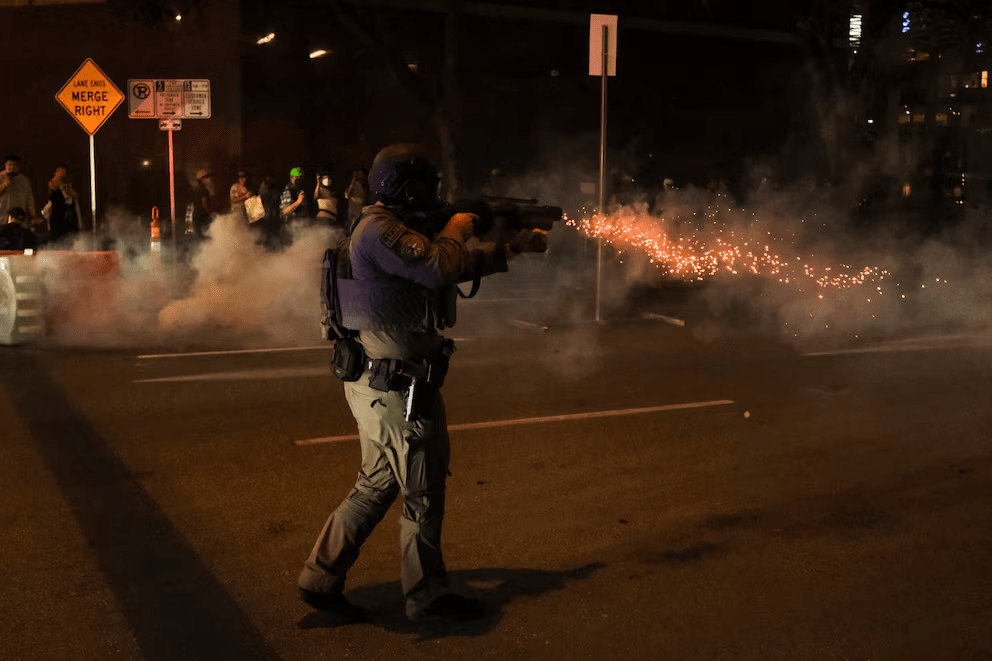
President Trump ordered the deployment of over 4,000 National Guard troops to Los Angeles, arguing it was necessary to contain demonstrations following recent immigration raids. The measure was taken despite local authorities reporting that the protests, though large, were mostly peaceful. The deployment of the National Guard in Los Angeles, ordered by President Donald Trump, represents an exceptional action in the recent history of the United States.

The deployment was announced on Saturday, and on Monday, Governor Newsom reported that the White House would send an additional 2,000 troops to the city.
What laws did Trump use to justify the measure?
Trump did not invoke the Insurrection Act of 1807, as other presidents have done in similar situations, but instead relied on Title 10 of the U.S. Code, which allows him to mobilize federal troops in cases of invasion, rebellion, or if he deems that law and order cannot be maintained through conventional law enforcement. When asked about the possibility of applying the Insurrection Act, he responded that it would depend on “whether there is an insurrection or not.”
Why is this measure unusual?
Typically, National Guard deployments to address protests require an explicit request from state governments.
The deployment in Los Angeles is the first since 1965 to occur without the consent of the local governor. On that occasion, President Lyndon B. Johnson sent troops to Alabama to protect civil rights demonstrators, defying Governor George Wallace.

What are the precedents for similar deployments?
The last National Guard deployment in Los Angeles took place in 1992, during the riots following the acquittal of police officers involved in the beating of Rodney King. At that time, both Governor Peter Wilson and Mayor Tom Bradley requested federal support, and President George H. W. Bush invoked the Insurrection Act. Those riots left more than 60 dead and 2,000 injured. In contrast, the current deployment occurs without a state request and in a context of lesser violence, according to official sources.
What actions has California taken in response to the federal decision?
The state of California filed a lawsuit against President Trump on Monday, arguing that the deployment is unconstitutional and violates the Tenth Amendment, which guarantees states’ sovereignty against federal authority. Newsom stated that Trump is “creating a crisis” and released images denouncing the poor conditions in which soldiers are living, sleeping in overcrowded makeshift facilities.
What is the political and legal impact of this measure?
The deployment of the National Guard without state consent sets a legal precedent with significant implications for the relationship between the federal government and the states. It reignites the debate over the limits of presidential power in the use of troops within the country, particularly when there is no declared internal armed conflict or an official request from state or local authorities.

It also fuels the confrontation between the White House and local governments over immigration, security, and state autonomy.
What is the Insurrection Act?
The Insurrection Act of 1807 authorizes the president to use the U.S. military to restore civil order when riots prevent the enforcement of federal laws. It is considered one of the most controversial emergency powers in the United States. It has been invoked in specific instances, such as in 1965 in Alabama and 1992 in Los Angeles, but was not used by Trump in this case, at least not yet.
What’s next?
As troops continue to arrive in Los Angeles, civil rights organizations and state authorities maintain legal and political pressure against the deployment. The outcome of California’s lawsuit will determine whether sending the National Guard without state consent can be considered valid under the current constitutional framework. Meanwhile, the federal government is evaluating the use of other legal tools if protests expand or escalate.
Image: Infobae