
The Last Trombone: Salsa Left Orphaned by the Bronx Rebel
The news hit the Latino community like a sledgehammer to the chest: Willie Colón has died at 75. This wasn’t just any musician; the engine that gave salsa its most dangerous roar, its streetwise aesthetic, and that criminal elegance that defined an entire generation in New York and the Caribbean has gone silent.
If you were expecting a cold encyclopedia obituary, you’re in the wrong place. Here, we’ll break down why, without the ‘King of the Trombone,’ the music you hear at your family gatherings simply wouldn’t exist as you know it.

Quick Answer: The Fania All-Stars legend, Willie Colón, died at 75 after a career spanning more than six decades. He was the architect of the ‘Nuyorican’ sound, fusing jazz, Afro-Caribbean rhythms, and street lyrics. His legacy includes masterpieces like Siembra and Cosa Nuestra, albums that transformed salsa from a dance genre into a political and social manifesto.
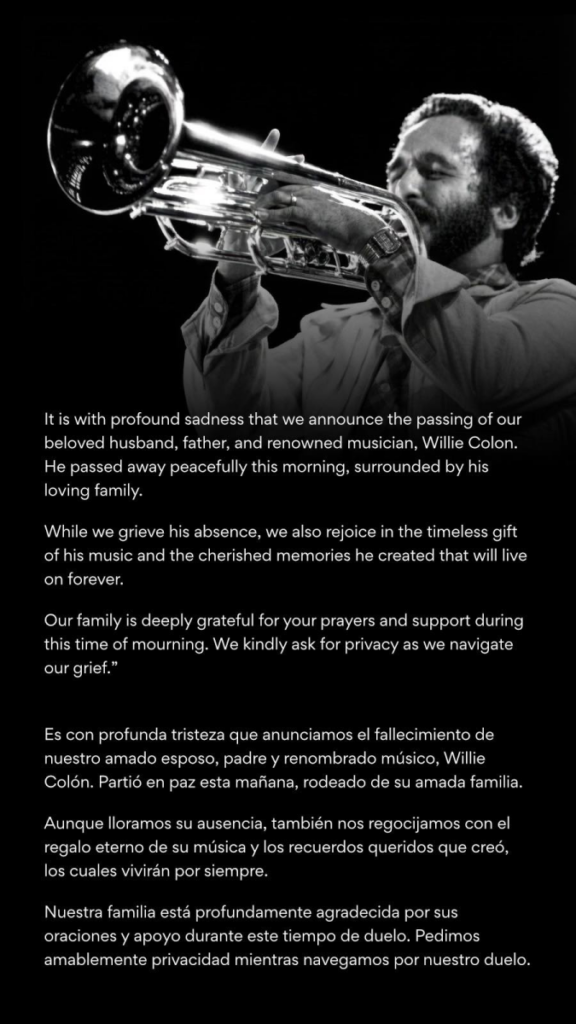
The ‘Bad Guy’ Who Made Us Proud: Who Was Willie Colón, Really?
To understand the void his passing leaves, we must go back to the Bronx of the 1960s. Willie wasn’t the most technically skilled trombonist in the world (he admitted it himself with the brutal honesty that defined him), but he was a marketing and sound visionary.
While others sought the perfection of big orchestras, Colón pursued the ‘asphalt sound.’ His early albums with Héctor Lavoe weren’t just music; they were crime chronicles.
- The gangster aesthetic: Willie used the ‘The Hustler’ image to connect with Latinos who felt marginalized in the U.S.
- The golden duo: His partnership with Héctor Lavoe is arguably the most important collaboration in tropical music history.
- Sound innovation: He introduced the trombone as a lead voice, breaking the dominance of bright trumpets to make way for a fatter, darker, and more aggressive tone.
The Impact of *Siembra* and the Alliance with Rubén Blades
If Willie conquered the neighborhood with Lavoe, he conquered Latin America’s intellect with Rubén Blades. The album Siembra (1978) wasn’t just a commercial success; it was a cultural earthquake.
Are we truly aware of what ‘Pedro Navaja’ meant? It was the first time a seven-minute song, without an immediate catchy chorus and with police sirens in the background, became an anthem for an entire continent. Willie Colón was the architect who provided the musical structure so Blades’ poetry could soar. Without Willie’s production, intellectual salsa would have remained in poets’ cafés and never reached mainstream radio.

| Crucial Album | Year | Why It’s Indispensable |
| Cosa Nuestra | 1969 | Defined the ‘hustler’ sound and Nuyorican pride. |
| Lo Mato | 1973 | The peak of his era with Héctor Lavoe. |
| Siembra | 1978 | The best-selling salsa album in history (at the time). |
| Fantasmas | 1981 | His consolidation as a soloist and leading voice. |
Beyond the Notes: Activism, Politics, and Controversy
Willie Colón was never a man of half-measures. His Twitter account (now X) was a battleground. He was loved for his music and often questioned for his outspoken political stances on Venezuela, Cuba, and U.S. domestic policy.
Why does this matter today? Because it reflects the complete artist. Willie didn’t want to please everyone; he wanted to be heard. His involvement in New York politics and his work as a sergeant in the New Rochelle Marshal’s Department show that his commitment to the community went far beyond the stage lights.
- Civil rights advocate: He always spoke out about the treatment of Hispanics in the Big Apple.
- System critic: His lyrics, even the most danceable ones, hid barbs against corruption and inequality.
The Void in Fania and the Future of the Clave
With his death, the Fania All-Stars lose one of their last original titans. Johnny Pacheco, Celia Cruz, Cheo Feliciano, and Héctor Lavoe are already gone. Willie’s passing feels like the definitive closing of a chapter that won’t be written again.

The truth is that today’s industry is unlikely to produce another Willie Colón. Music is now manufactured in algorithm labs; Willie made it with sweat, the smell of gunpowder from the streets, and a horn section that sounded like it was about to break but always kept the swing.
Image: LaOpinion.com